ARCHITECTAI
An AI-powered solution architecture configurator for Solutions Engineers and Technical Account Managers — turning a business problem into a complete architecture recommendation in under 2 minutes.
Intake → Discovery → Architecture in 3 structured steps
SEs & TAMs ANSWER
ARCHITECTURE QUESTIONS
FROM MEMORY
Every discovery call surfaces "what would this look like in production?" — and the answer is usually improvised.
Inconsistent recommendations — different SEs propose different stacks for the same problem context
Slow constraint modeling — "what if their budget is lower?" means rebuilding the whole proposal from scratch
Lost discovery context — follow-up questions aren't structured, so the rationale behind architectural choices gets lost
No visual output — whiteboard diagrams don't travel well into written proposals or async stakeholder reviews
THREE STEPS TO A
COMPLETE RECOMMENDATION
Problem Description
Describe the business problem in plain language. Load a demo scenario or type your own. Minimum context to get architecture-quality output.
Structured Follow-Up
GPT-4o mini generates 2–3 targeted questions — each designed to change the architecture recommendation if answered differently.
Full Recommendation
GPT-4o returns a system diagram, tech stack with rationale, and a 500-word Solution Brief with trade-off analysis — structured via OpenAI function calling.
QUESTIONS THAT
CHANGE THE ANSWER
The discovery prompt is engineered so each question is architecture-changing — not generic clarification. Example output for a SaaS B2B platform:
Will you be storing personally identifiable information, requiring HIPAA or GDPR compliance?
↳ CHANGES: data residency, encryption at rest, auth provider, audit loggingAre your workloads consistently distributed or do you expect significant traffic spikes — for example, driven by seasonal demand or triggered events?
↳ CHANGES: compute model, auto-scaling strategy, CDN layer, queue architectureDo you have an existing engineering team and infrastructure, or is this greenfield with a small founding team?
↳ CHANGES: managed vs. self-hosted, IaC complexity, ops overhead assumptions
THREE VIEWS,
ONE RECOMMENDATION
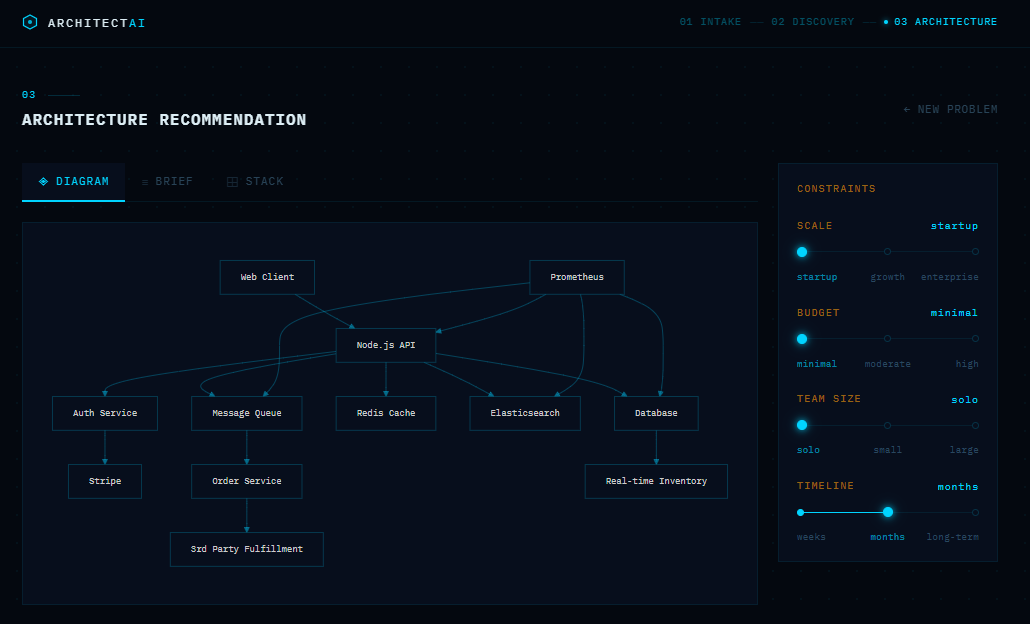
System Diagram
Mermaid.js architecture diagram rendered from GPT-4o's structured output. Shows data flow between all major components.
Client[Web Client] --> CDN
CDN --> API[FastAPI Gateway]
API --> Auth[Auth Service]
API --> DB[(PostgreSQL)]
API --> Cache[(Redis)]
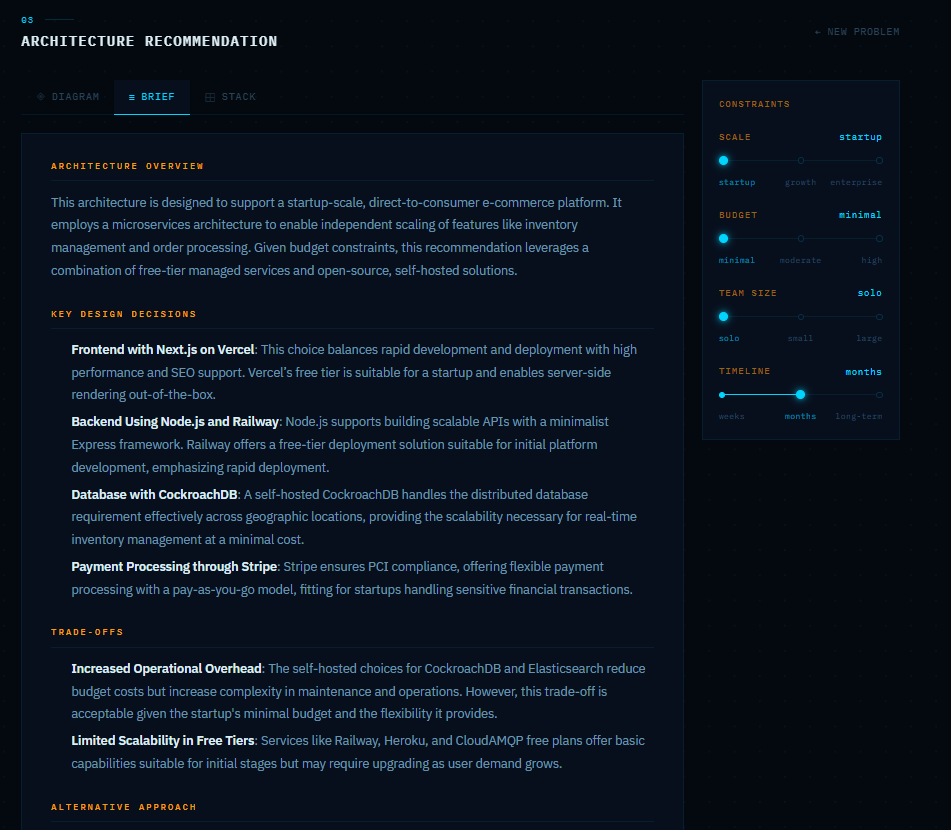
Solution Brief
450–600 word written brief covering architecture overview, key design decisions, trade-offs, and one credible alternative approach.
## Key Design Decisions
• PostgreSQL 16 on RDS...
• Redis 7 for session...
## Trade-offs
## Alternative Approach
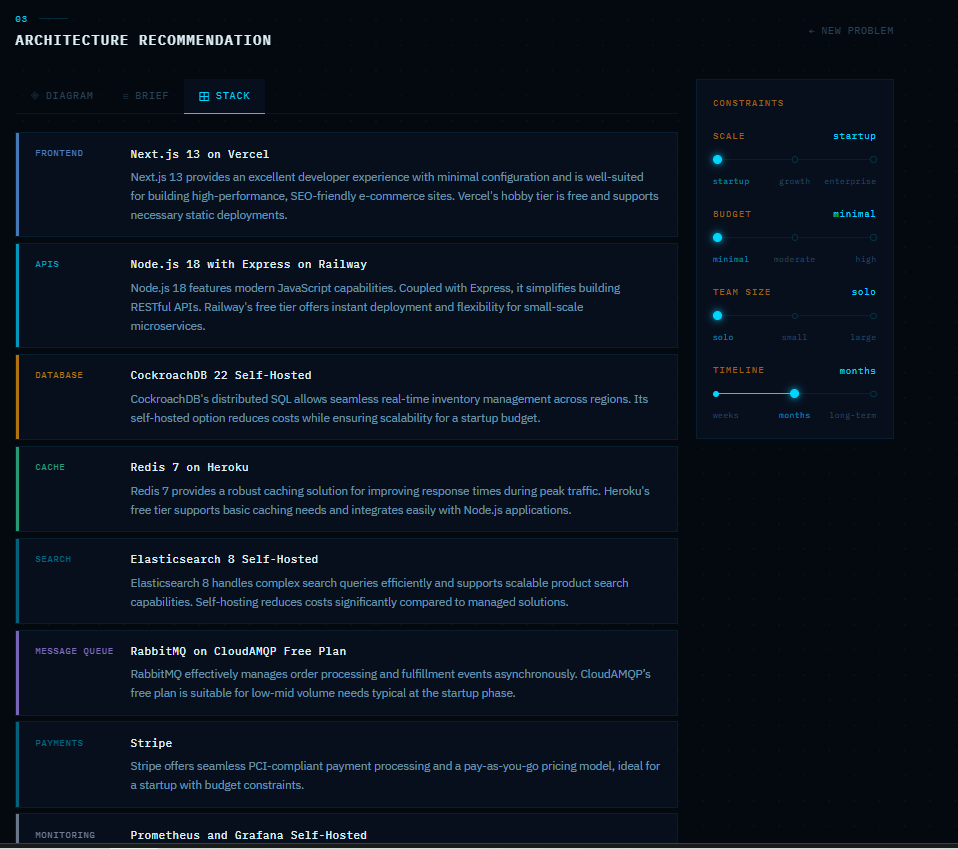
Tech Stack
5–8 architectural layers with specific technologies, versions, and 1–2 sentence rationale referencing the stated constraints.
API LAYER FastAPI on Railway
DATABASE PostgreSQL 16 on RDS
CACHE Redis 7 Cluster
AUTH Clerk
REACTIVE
CONSTRAINT MODELING
Adjust scale, budget, team size, or timeline on the results page. The recommendation regenerates within 800ms — no re-running the full flow.
Constraints
WHERE THIS TOOL
FITS THE WORKFLOW
Pre-Sales Discovery
Load the prospect's problem before a call. Run through the discovery questions to stress-test your architecture assumptions before you're live on a demo.
Live Architecture Walkthroughs
Input a problem during a call and walk the prospect through the recommendation in real time — diagram, rationale, and trade-off analysis all included.
Proposal Acceleration
Use the Solution Brief as a structured starting point for a formal proposal. Eliminates the blank-page problem and ensures consistent sections every time.
Constraint Sensitivity Modeling
When a prospect says "what if we only have half the budget?" — adjust the slider and show the updated recommendation immediately, without leaving the page.
5 PRELOADED
DEMO SCENARIOS
Diverse domains — each producing a meaningfully different architecture output. Load any scenario in one click, no setup required.
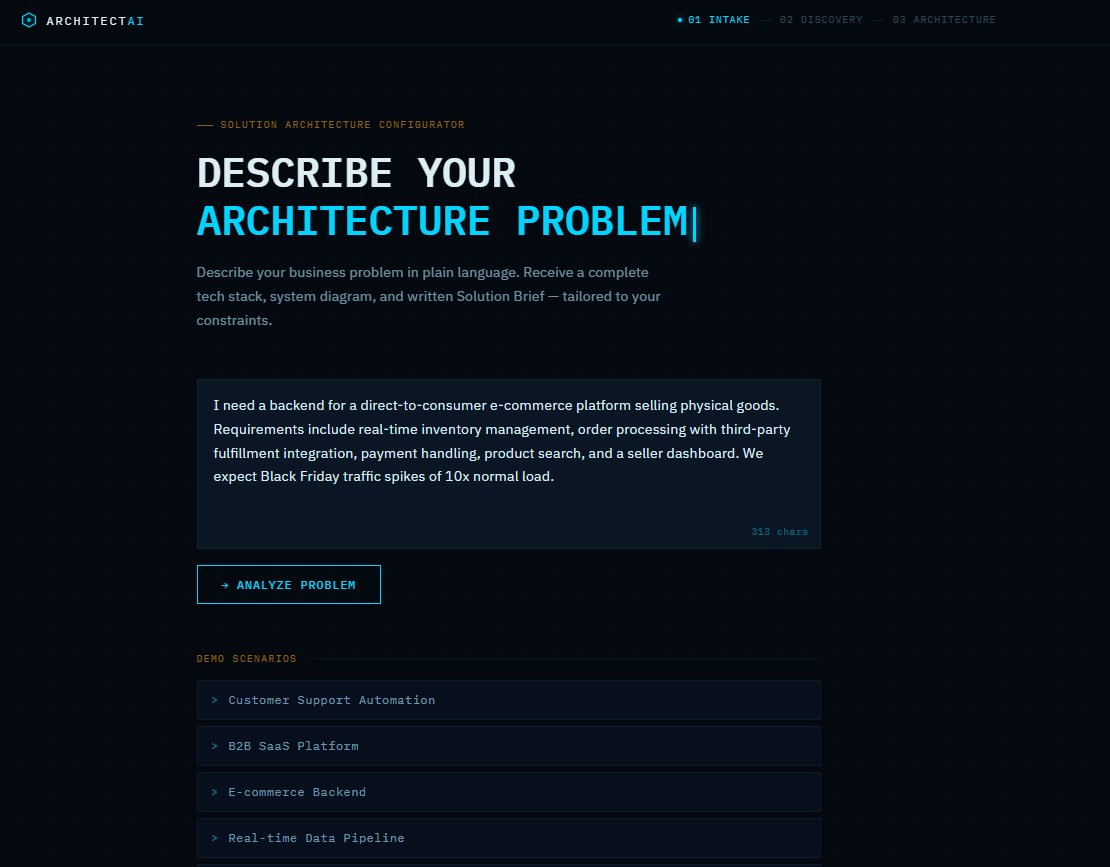
PROBLEM
INTAKE
Plain-language problem input with five one-click demo scenarios.
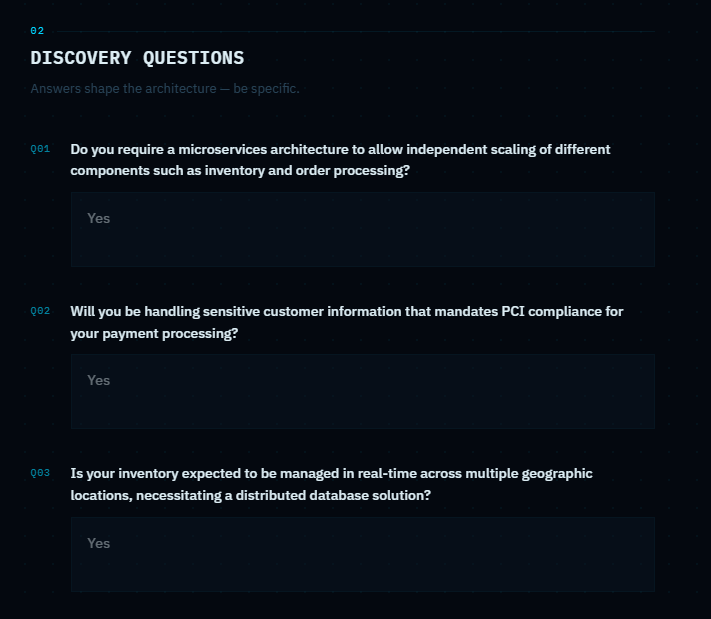
DISCOVERY
QUESTIONS
AI-generated follow-ups — each one changes the architecture if answered differently.
ARCHITECTURE
RECOMMENDATION
THE META-ARCHITECTURE —
HOW ARCHITECTAI IS BUILT
API key never touches the browser — all LLM calls are server-side
BUILT TO DEMONSTRATE
TECHNICAL DISCOVERY
& SOLUTION DESIGN
ArchitectAI models the core SE/TAM competency — turning ambiguous requirements into structured, rationale-backed architecture recommendations. It's also a working portfolio artifact that can run live in any interview.
Run locally: uvicorn main:app --reload && npm run dev → localhost:5173